Sector 102. // Kenny Who?
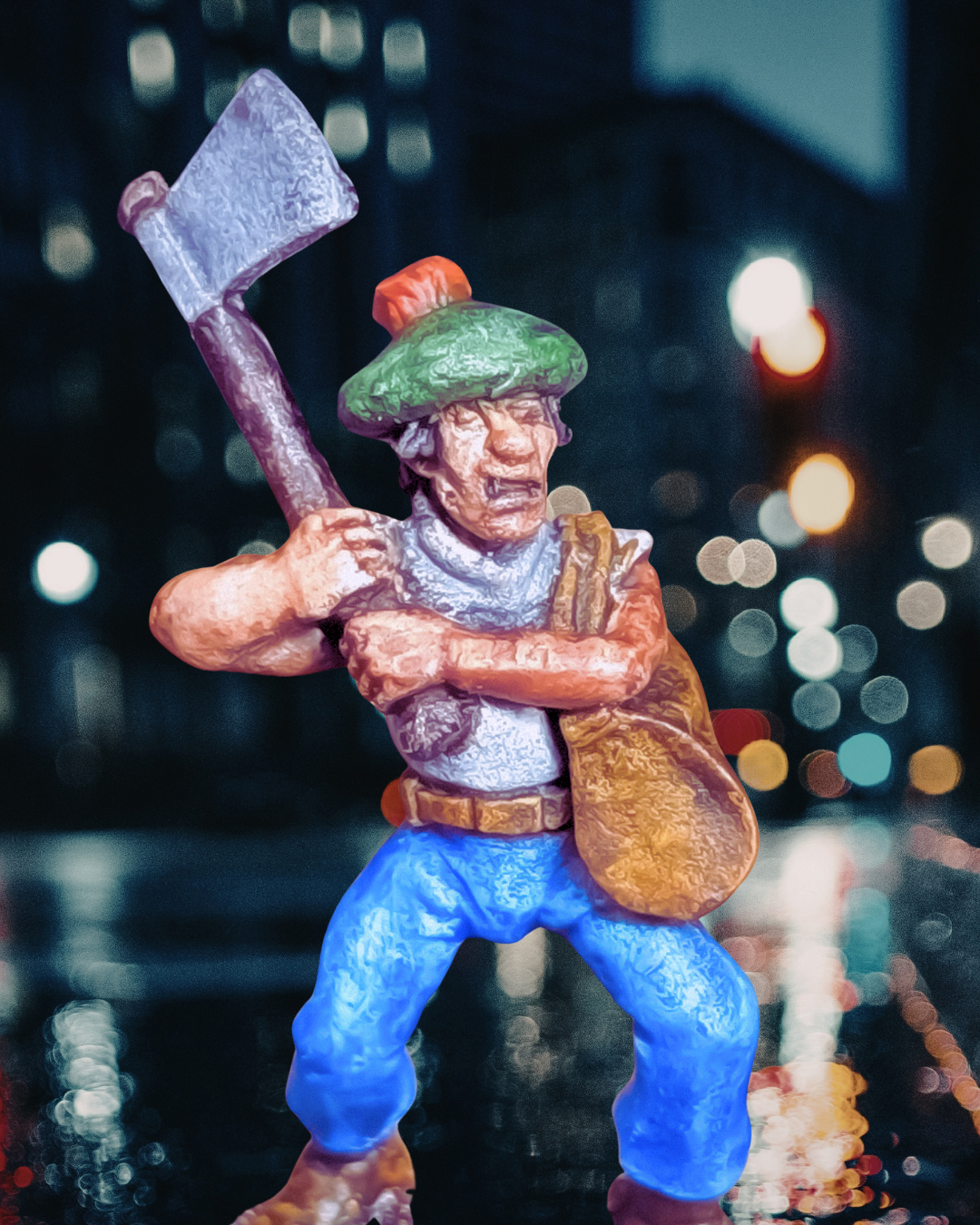
Kenny Who? is one of those obscure Judge Dredd characters who started out as a joke but ended up becoming a surprisingly memorable part of the wider 2000 AD universe. While he never achieved the fame of Judge Dredd himself, Kenny's appearances offered sharp satire, industry commentary, and some of the funniest stories ever published in the Judge Dredd setting.
Kenny Who? is a Scottish artist from Cal-Hab, the future version of Scotland in the Judge Dredd universe. He's a short red-haired man with blue eyes, usually depicted as being somewhere in his late thirties or early forties. He's married to Izzy Who? and has three children. At first glance, he seems like an ordinary working artist trying to make a living, but his stories quickly reveal a much more complicated character.
Kenny's biggest dream was to make it big in the trashzine market. In the world of Judge Dredd, trashzines are the futuristic equivalent of comic books, sensational magazines, and tabloid entertainment all rolled into one. Kenny believed his artistic talent could earn him success in this industry, but as often happens in Mega-City One, things rarely worked out the way he hoped.
One of the most famous aspects of the character is his name. His surname is literally "Who?" complete with the question mark. This became a recurring joke every time he introduced himself. Characters would ask his name.
"Kenny Who?"
"That's what I'm asking."
"Who?"
"Kenny Who?"
The conversation would spiral into confusion as people repeatedly misunderstood that the question mark was actually part of his surname. The joke was clearly inspired by classic comedy routines such as Abbott and Costello's famous "Who's on First?" sketch, and it became Kenny's trademark throughout his appearances.
Kenny first appeared in 2000 AD Prog 477 in 1986. However, beneath the humor was a surprisingly sharp piece of satire aimed directly at the comic-book industry itself.
At the time, many British comic publishers did not provide royalties to artists and writers whose work generated profits. Creators often received a one-time payment while publishers retained ownership and continued earning money from the material. This was a major source of frustration within the industry. The writers behind Kenny Who? turned this issue into a Judge Dredd story.
In his debut appearance, Kenny discovers that comic editors have effectively stolen his artistic style. Rather than hiring him or compensating him, they create a robot capable of producing artwork identical to his. The machine copies his unique approach while the publishers profit from the results. Naturally, Kenny is furious. His anger boils over and he begins assaulting the editors responsible. This attracts the attention of Judge Dredd, who arrests him for his actions. On the surface, the story is a comedy. But underneath, it serves as a direct criticism of publishers benefiting from creative talent without properly rewarding the creators themselves.
What makes Kenny particularly interesting is that he isn't portrayed as a perfect victim. He's talented and sympathetic, but he's also hot-tempered and prone to explosive outbursts. When pushed too far, he can become extremely aggressive. This combination makes him feel more human than many purely comedic characters. Despite his flaws, readers could understand why he was angry. He wasn't simply looking for fame. He wanted recognition and fair treatment for his work. The story resonated with readers because it reflected real frustrations experienced by artists and writers in the comic industry. In many ways, Kenny Who? represented the creative people behind the scenes who often struggled to receive proper credit for their contributions.
Interestingly, the real-world situation eventually changed. British comics gradually moved away from some of the policies being criticized, including issues surrounding creator compensation and royalties. But Kenny's popularity ensured that he wouldn't disappear after a single story. He returned in later comedy sequels that continued to explore both the absurdity of the Judge Dredd universe and the challenges faced by creative professionals. His final major appearance may be his most memorable. By this point, Kenny has created a new trashzine hero called The Hoolie.
The Hoolie is essentially a rebellious champion who fights against corruption and injustice. More importantly, the stories feature corrupt Judges led by an obvious parody called Judge Dread.
As you might imagine, the authorities are not amused. Kenny struggles to find a publisher willing to touch the material. Nobody wants to risk angering the Justice Department by printing stories that portray Judges as villains. Rather than give up, Kenny decides to self-publish. What happens next is completely unexpected. The Hoolie becomes a massive success. Readers love it. Sales explode. The trashzine turns into a cultural phenomenon. For perhaps the first time in his life, Kenny achieves the success he always dreamed about. But in Mega-City One, success often attracts unwanted attention. The Judges arrest him for defaming the Justice Department. After all, his comic portrays corrupt Judges abusing their power. From the perspective of the authorities, that is unacceptable criticism.
This storyline allows the writers to satirize censorship, freedom of expression, and government sensitivity to criticism. Once again, Kenny finds himself at the center of a conflict that reflects real-world issues. The case eventually goes to appeal. Kenny is defended by Public Defender 314, who challenges the conviction. In a fittingly absurd Judge Dredd twist, the conviction is overturned on technical grounds rather than because the system suddenly embraces free speech. Nevertheless, the result is a victory for Kenny. His record is cleared. The authorities are forced to back down and Kenny returns home to Cal-Hab in triumph.
It's a surprisingly uplifting ending for a character who spent much of his existence struggling against unfair treatment and institutional power. Looking back, Kenny Who? occupies an unusual place within Judge Dredd history. He's not a major villain. He's not an action hero. He's not even particularly influential within the wider continuity. Yet he remains memorable because his stories tackled real issues through humor and satire. The character gave writers an opportunity to comment on the comics industry itself. Through Kenny, they discussed creator rights, artistic ownership, censorship, publishing practices, and the relationship between artists and powerful institutions. At the same time, the stories never lost their sense of humor. Whether he was arguing with confused strangers about his name, attacking exploitative editors, or accidentally creating a best-selling anti-Judge comic, Kenny always remained entertaining. Perhaps that's why readers continue to remember him decades after his first appearance. He represented the underdog creator trying to make a living in a system stacked against him. He was talented but flawed. Funny but relatable. A joke character with genuine substance underneath the comedy. And while he may never be as famous as Judge Dredd, Kenny Who? remains one of the most clever and distinctive supporting characters ever to emerge from the pages of 2000 AD.