Book Review // The Greater Festival of Masks by Thomas Ligotti
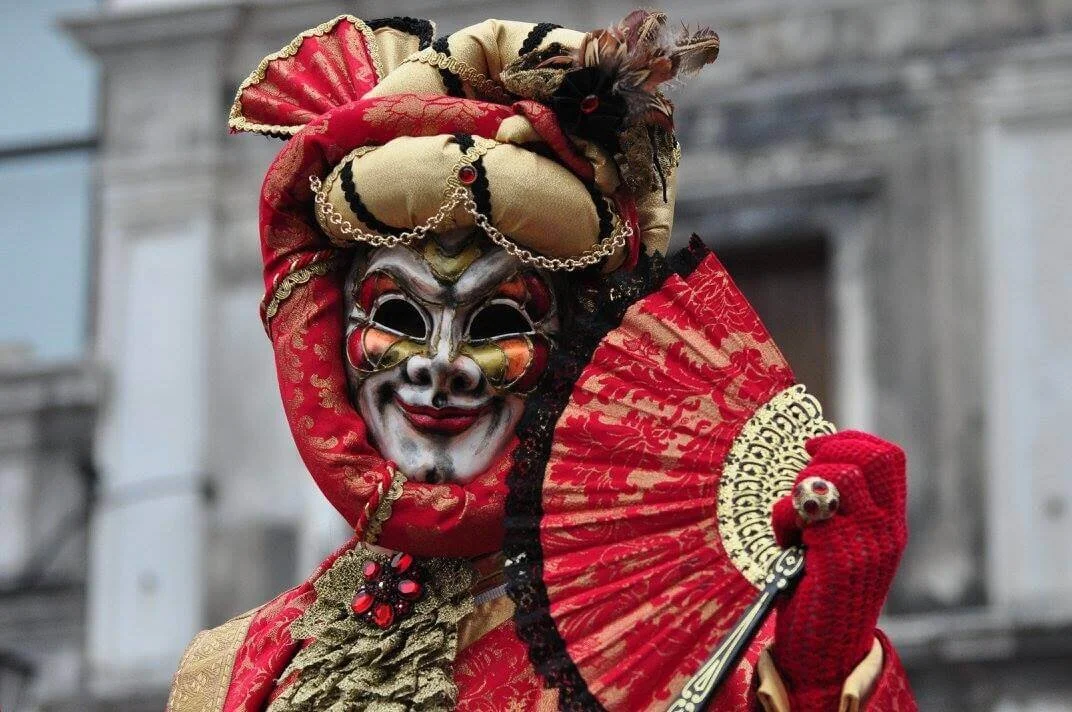
I’m continuing my dive into modern horror authors, and this time I’ve stumbled across The Greater Festival of Masks by Thomas Ligotti, first published in 1985.
There doesn’t seem to be a great deal of information about this particular story floating around. Whether that’s because it’s a short story or because it tends to appear in larger collections, I’m still trying to work out. I found it in Darkness: Two Decades of Modern Horror, which is turning into a useful little collection for my horror-reading adventures.
I’d never read anything by Thomas Ligotti before. In fact, I hadn’t even heard of the man. So I went into this one completely blind. Sometimes that’s the best way to discover a new horror author. Other times, you finish the story wondering what the DROKK you’ve just read!
The Review
One thing I can say straight away is that Ligotti knows how to create an atmosphere. We follow a traveller named Noss, who finds himself in a rather peculiar city in the middle of a festival. The celebrations revolve around masks, and before long, Noss enters a crowded, unsettling shop selling carnival masks, and this is where things start to get weird.
Noss somehow ends up in charge of the shop he's just walked into. Quite how everyone accepts this arrangement so readily is beyond me, but then again, this isn't exactly a story where things feel normal. From there, he's tempted by the masks and drawn into the backyard, where he gets a closer look at the festival taking place around him.
The descriptions of the city, its strange inhabitants and the general atmosphere were some of my favourite parts of the story. Ligotti creates a setting that feels wonderfully wrong, as though the world itself has slipped slightly out of alignment. Unfortunately, I also started losing my grip on the plot. I struggled to work out whether Noss was experiencing events in the real world, wandering through some sort of dreamscape, or caught somewhere between the two.
Now, I appreciate that this uncertainty may well be the point. Horror doesn't always need to explain itself, and sometimes the feeling that something is fundamentally wrong is far more effective than having everything neatly explained. But I found the experience a little jarring, and I struggled to stay connected to what was happening.
The idea behind the festival is what really stuck with me. As I understood it, the celebrations involve wearing two different masks. The first smooths away your existing features, while the second gives you a new face. There's something wonderfully unsettling about that idea: stripping away your identity before putting on another face to present to the world. It also ties into the wider feeling that nothing in this city is quite what it seems.
Even the buildings are deceptive. Doors lead nowhere, balconies have no way of being reached, and stairways connect to nothing. Everything appears to imitate something else, creating a world built on appearances rather than anything real. It's a great concept. The masks aren't simply creepy decorations worn by festivalgoers; they seem to reflect a world where authenticity has disappeared and everything is pretending to be something it isn't.
I would have liked to feel more confident that I understood what Ligotti was doing with these ideas, but there's enough here to get the imagination working. While reading this, I couldn't help getting strong The King in Yellow vibes. There's that same sense of an unsettling world where reality becomes difficult to trust, with strange surroundings, disturbing imagery and the nagging feeling that something is terribly wrong beneath the surface.
I’m not claiming the two are directly connected, but the atmosphere brought that kind of weird horror to mind. It's less about a straightforward monster jumping out at you and more about being somewhere that makes you question what you're seeing, and then there's the masks themselves.
I've always had a bit of a thing for faceless horror. It's one of the reasons I enjoy films such as Halloween, Friday the 13th and The Texas Chain Saw Massacre. There's something unnerving about a killer whose face gives you nothing to read, someone who hides their identity behind a mask and becomes something separate from the person underneath. So, a whole city full of masked people? Yeah, that's going to get under my skin!
The idea of wandering through a festival surrounded by people whose faces are hidden, in a city where even the buildings are pretending to be something they're not, is genuinely creepy. Ligotti's story taps into that fear rather effectively, even when I wasn't entirely sure what was happening.
Final Thoughts
The Greater Festival of Masks left me with mixed feelings. I enjoyed the rich descriptions, the strange setting and the unsettling imagery. The masks themselves were a particular highlight, playing into my own enjoyment of faceless horror. There's a wonderfully creepy idea at the heart of this story, and Ligotti certainly knows how to make a place feel wrong. On the other hand, I struggled with the plot and found myself getting lost in the dream-like events. Perhaps that's part of the experience, and perhaps another Ligotti story will help me appreciate his approach a little more.
This was my first encounter with Thomas Ligotti, so I'm not ready to make any grand declarations about his work just yet. I suspect I'll need to read more before I can decide whether his particular brand of horror is for me. Still, I'm glad I gave it a go. A story that leaves me confused isn't necessarily a bad story, especially when it also leaves me thinking about its ideas and imagery afterwards.
And if there's one thing I've learned from this little adventure, it's that a city full of people wearing masks is somewhere I probably wouldn't want to spend my holidays. Have you read anything by Thomas Ligotti? Is there a story you'd recommend for someone just starting to explore his work? Let me know!
Cheers for reading, and I'll see you on the next adventure!