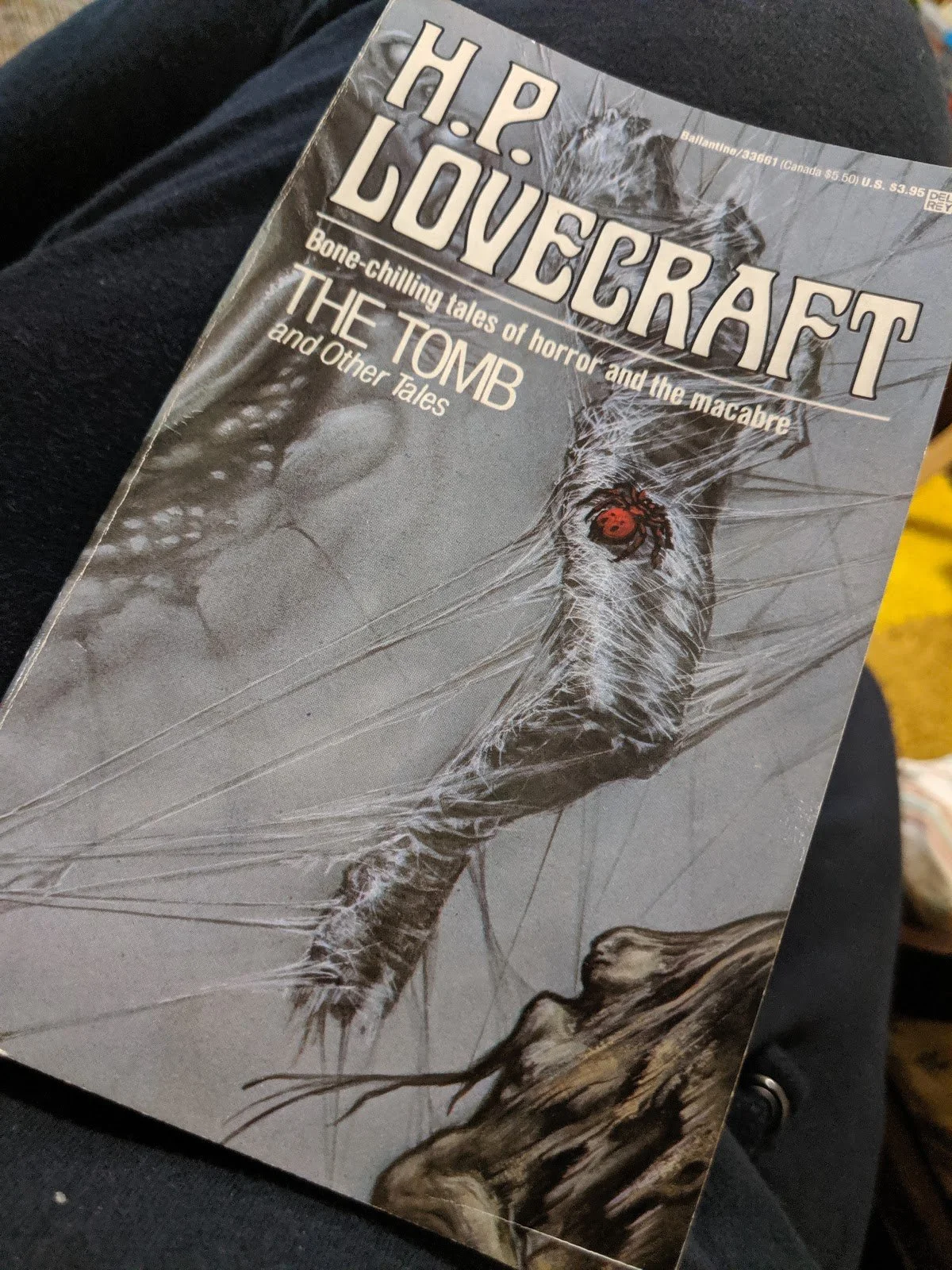
After having such a good time with Wrath of N'Kai, I found myself wanting to dive a little deeper into the works of H.P. Lovecraft. So, back to the reading pile we go, and this time we're exploring some of his earlier short stories.
Originally, I was going to review each tale separately, but most of these are fairly short. So rather than bombard you with a series of tiny reviews, I've decided to bundle them together into one little collection. Let's see what we've got!
The Tomb
First up is the title piece, The Tomb.
Originally written in 1917, this was Lovecraft's first adult story. What's particularly interesting about it is that there are no Elder Gods, no ancient cosmic horrors and no great Mythos revelations. Instead, it's a straight-up psychological horror story.
We follow a young boy who discovers the entrance to a long-abandoned mausoleum. The family who once occupied the nearby mansion are believed to have died out following a devastating fire. But as the boy grows into a man, his fascination with the tomb becomes an increasingly troubling obsession.
There are some unusual jumps through time and some rather strange dreams that give the story an interesting twist. The ending is also a little sad for our main character, who ultimately finds himself locked away and regarded as insane.
All in all, a great opener. It's a little short, but there's plenty here to enjoy.
The Festival
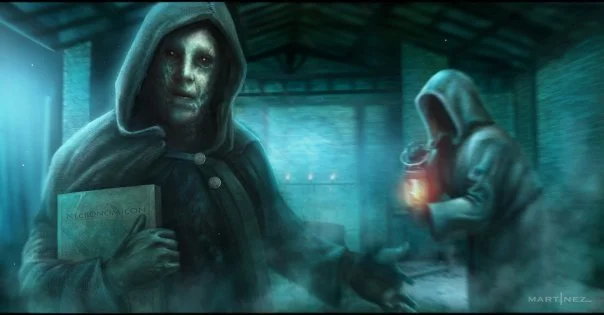
A Christmas tale, if H.P. Lovecraft ever actually wrote one! The Festival follows a young man who is called back to his ancestral home in Kingsport for the Yuletide celebrations. Almost immediately, things feel a little off. The locals behave strangely towards him, and his accommodation is a run-down, damp old house.
While exploring, he discovers a copy of the Necronomicon. Then, as the bells begin to chime, he is led towards a church that hides a mysterious underground cave system. This is also where we get one of the early appearances of the Byakhees, creatures that would become a familiar part of the wider Mythos.
This is exactly the sort of Lovecraft I enjoy. Highly descriptive, wonderfully atmospheric and full of that creeping sense that something ancient and unpleasant is happening just out of sight. An amazing little read, and it's easy to see how Lovecraft was developing the ideas that would eventually become the Cthulhu Mythos.
Imprisoned with the Pharaohs
Now here's an interesting one. Credit to Lovecraft and Harry Houdini for this tale, although apparently Houdini didn't contribute quite as much as you might expect! The story is presented as a Houdini adventure, and it reads a little like an Indiana Jones escapade. We follow the famous escape artist through an Egyptian adventure involving ancient secrets, strange discoveries and plenty of danger.
It's an interesting change of pace, but if I'm honest, it was only okay. I found it easily forgettable, and it strayed a little too far from the sort of Lovecraft horror I enjoy. Not a terrible story, just not one that particularly stuck with me.
He
Based on Lovecraft's own experiences during his time in New York City, He attempts to bring an evil sorcerer into the modern urban setting. Unfortunately, I don't think it really works. More than anything, this story showcases the racism and prejudice that were part of Lovecraft's worldview. It's an awkward read, and the xenophobic attitudes make it difficult to enjoy the story on its own merits.
We'll swiftly move on.
The Horror at Red Hook
I hate to say it, but we're dealing with another xenophobic tale from Lovecraft. At least here, I felt the subject matter was handled slightly better than in He, although that certainly doesn't make the underlying attitudes any less uncomfortable.
We join a police officer named Malone as he investigates a recent surge in illegal immigration in the Red Hook area. The clues eventually lead him to an abandoned church, which is raided and revealed to be a centre for smuggling operations. But, of course, that's not the end of the story.
The investigation uncovers something much stranger: dark, long-forgotten cults, strange rituals and the possibility that something evil has been brought back from a time when it should have remained forgotten. There is a genuinely interesting horror story buried in here, with some excellent atmosphere and a suitably disturbing mystery. But you really do have to be prepared for the xenophobic comments that run through it.
Read with caution!
The Strange High House in the Mist
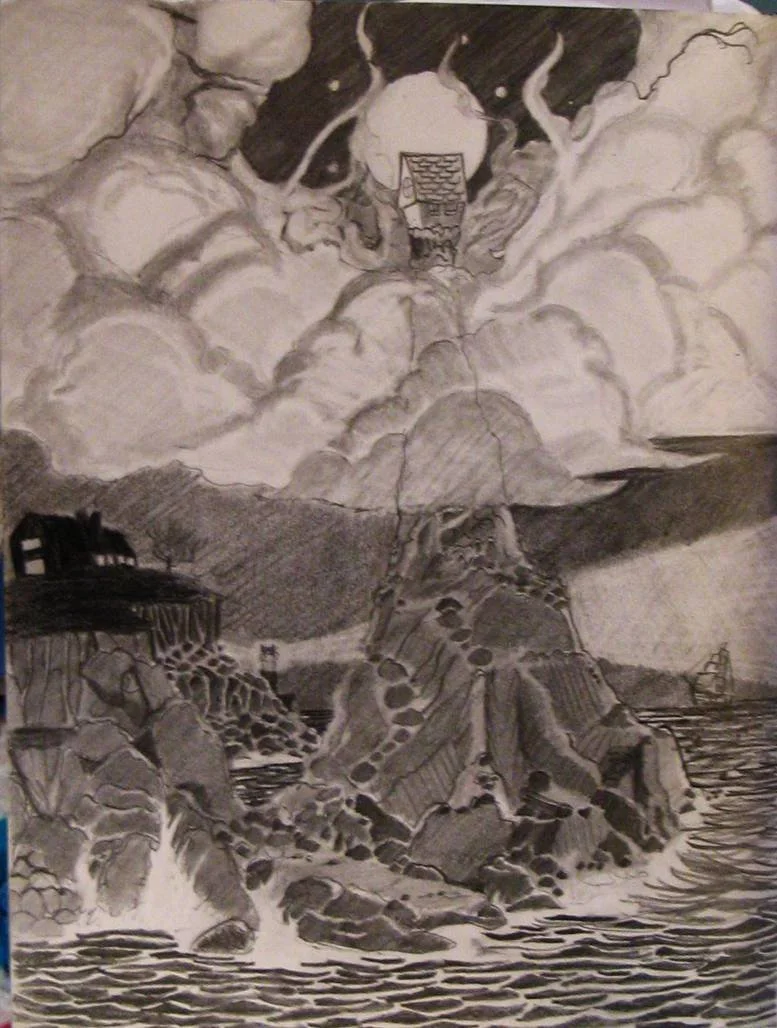
Now we're getting back to the more classical Lovecraft style. We have a professor, an isolated New England setting and a creepy house perched somewhere that really doesn't invite visitors. You know the sort of place: the one where any sensible person would take one look and decide that perhaps exploring it isn't the best idea.
It's a short, creepy tale that does a wonderful job of creating atmosphere. There's a real sense of mystery surrounding the house, its location and what might be happening there.
As is often the case with Lovecraft, you're left wondering just how far the threat might extend. A great little story.
In the Walls of Eryx
A science-fiction story with all the twists and turns you'd expect from Lovecraft. I honestly hadn't realised he'd experimented with this sort of science fiction, so I was particularly intrigued by this one.
Set on a newly colonised Venus, we follow a brave mineral prospector as he travels across the planet in search of a rare mineral. The problem? That mineral is normally protected by a native lizard-like race, who are considered inferior to humanity.
Things take a turn when our prospector becomes trapped inside an invisible maze, apparently constructed by the very creatures he believes to be beneath him.
It's a great read, and I couldn't help feeling sorry for the poor prospector as he struggles to escape his predicament.
There's also an interesting twist in how the story challenges the assumptions made about the native inhabitants. A very enjoyable change of direction, and one of the highlights of the collection for me.
The Evil Clergyman
And now we reach The Evil Clergyman, described in this collection as Lovecraft's final written piece. This is a very short tale, and I have to admit that I struggled with it. We have a character alone in a room who, for reasons I couldn't quite get my head around, appears to be able to swap bodies and possibly travel back in time to become an apostate from an earlier period. Or at least, that's how I interpreted it!
I didn't particularly enjoy this one, but that may simply be because I wasn't entirely sure what was happening. It feels as though there's an interesting idea here, but the limited page count doesn't give it much room to develop. If you've read this one and can explain what I've missed, please drop a comment below. I'd genuinely love to hear your interpretation!
Early Tales and Fragments
The collection finishes with a little extra material titled Early Tales and Fragments. These are exactly what they sound like: early pieces of writing, unfinished ideas and fragments of stories that were never fully developed. If you're a Lovecraft fan, there's probably some interest in seeing these earlier ideas and getting a glimpse of how his writing evolved. But if you're simply looking for a collection of complete stories, I'd say you can probably skip past this section. They don't add a great deal to the overall experience.
Final Thoughts
Overall, The Tomb and Other Short Stories is a solid collection, particularly if you're interested in exploring Lovecraft's earlier work. There are some cracking little stories in here, with The Festival and The Strange High House in the Mist being particular highlights for me. I also really enjoyed the unexpected science-fiction direction of In the Walls of Eryx.
Not everything lands, though. A couple of the stories are difficult reads because of Lovecraft's xenophobic attitudes, while others simply didn't grab me. And The Evil Clergyman left me scratching my head! But that's part of exploring an author's work, isn't it? You get the good, the bad and the downright confusing.
If you're looking for quick, punchy stories that offer a taste of Lovecraft's developing horror style, this is well worth a look. If you're after something more substantial to sink your teeth into, you might be better off looking elsewhere. I'm certainly not finished exploring Lovecraft just yet. After Arkham and now these earlier tales, I'm keen to see what else is waiting for me.
Cheers for reading, and I'll see you on the next adventure!