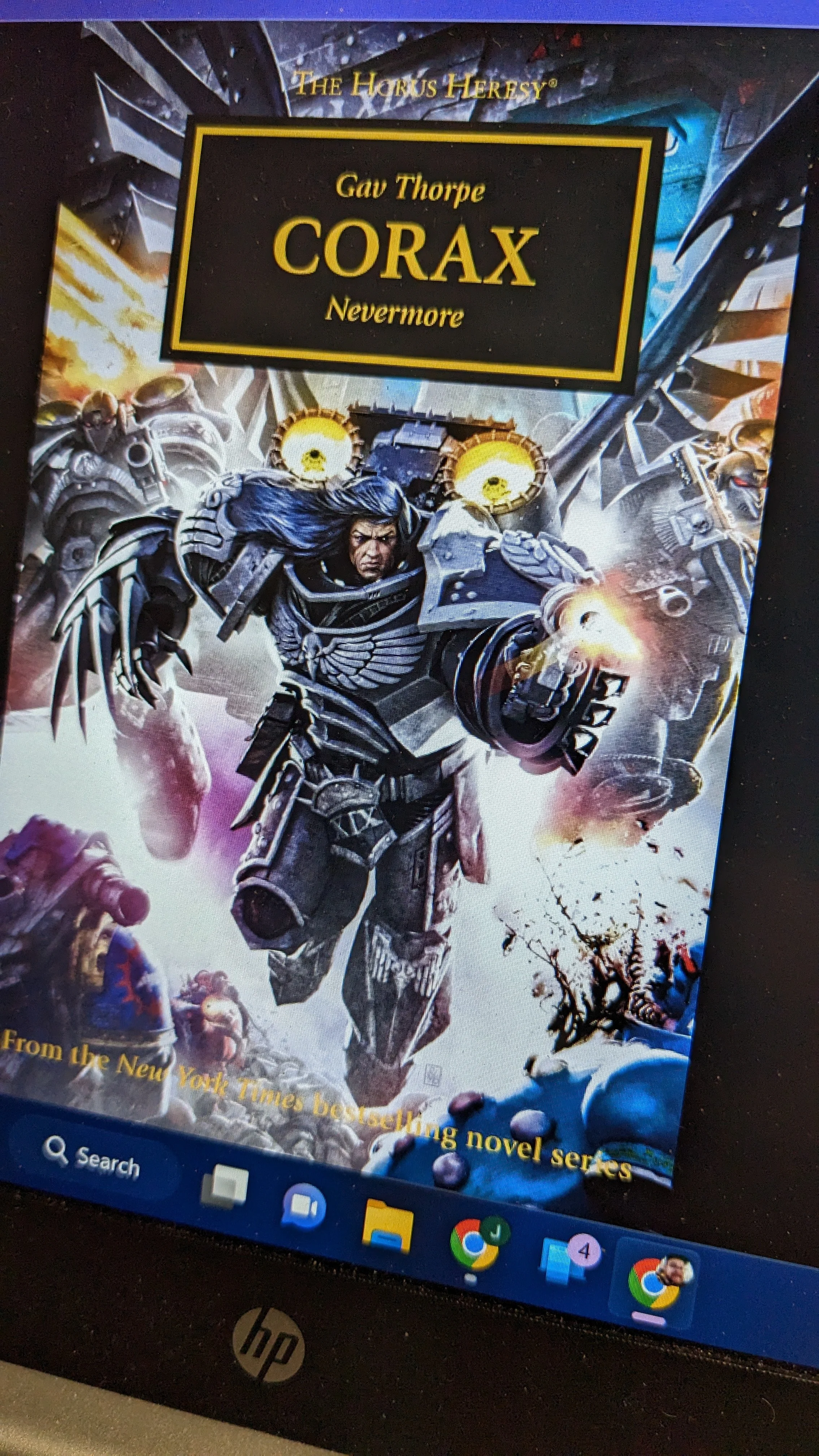
It's always nice to dip back into the Horus Heresy, today we're heading into the shadows with the Raven Guard and their Primarch, Corvus Corax.
Can you believe we're now at book number 40 in the Horus Heresy series? And we're still a fair way off finishing! At this rate, I'll be reading about the Siege of Terra sometime around the next millennium.
This time, we're looking at Corax by Gav Thorpe, an anthology collecting six stories about the Raven Guard's struggle to recover from the horrors of Isstvan, the consequences of their Primarch's desperate attempts to rebuild the Legion, and the darkness creeping into their ranks.
So, grab yourself a cup of coffee, find somewhere comfortable, and let's get going!
The Details
Title: Corax – The Horus Heresy #40
Author: Gav Thorpe
Format: Kindle
Blurb
The Lord of Ravens, Master of Deliverance, Primarch Corvus Corax of the Raven Guard takes centre stage in a collection of stories exploring his campaign of vengeance against Horus's allies and his desperate attempts to hold his Legion together.
After Isstvan and the events of Deliverance Lost, the Raven Guard continue to fight back against the Warmaster's forces. Corax has managed to stall the physical corruption of his Space Marines, but what of their spirits? And what terrible fate awaits those who dwell forever in the darkness?
This anthology collects the novellas Soulforge, Ravenlord and Weregeld, alongside the short stories The Shadowmasters, The Value of Fear and Raptor.
Six stories, one increasingly troubled Primarch, and a Legion struggling to work out whether its greatest enemy is Horus or itself.
The Review
Going into this book, I hadn't realised it was a collection of three short stories and three novellas. That immediately excited me! Lately, I've been struggling a little with longer novels. Sometimes, I want a story I can jump into, finish, take a breather from, and then return to when I'm ready. An anthology like this is perfect for that sort of reading. Now, I did briefly consider being cheeky and splitting this into six separate reviews. Six stories, six blog posts! That's six days of content sorted, right?
But that felt a little lazy, even by my standards. So instead, we're tackling the whole thing in one big post. You're welcome!
Weregeld – A Glimpse of the End
The book opens with a section of Weregeld, placing Corax and the Raptors alongside the Space Wolves and an injured Leman Russ as the traitorous forces of the Alpha Legion, World Eaters and Thousand Sons close in. It's an unusual way to begin because it throws us forward in the timeline before taking us back to the events that lead up to this confrontation. However, I rather liked the approach. It feels as though we're being shown the end of Corax's story before retracing his steps, learning about the decisions, losses and personal demons that brought him there.
And if this opening is anything to go by, we're in for a grim ride.
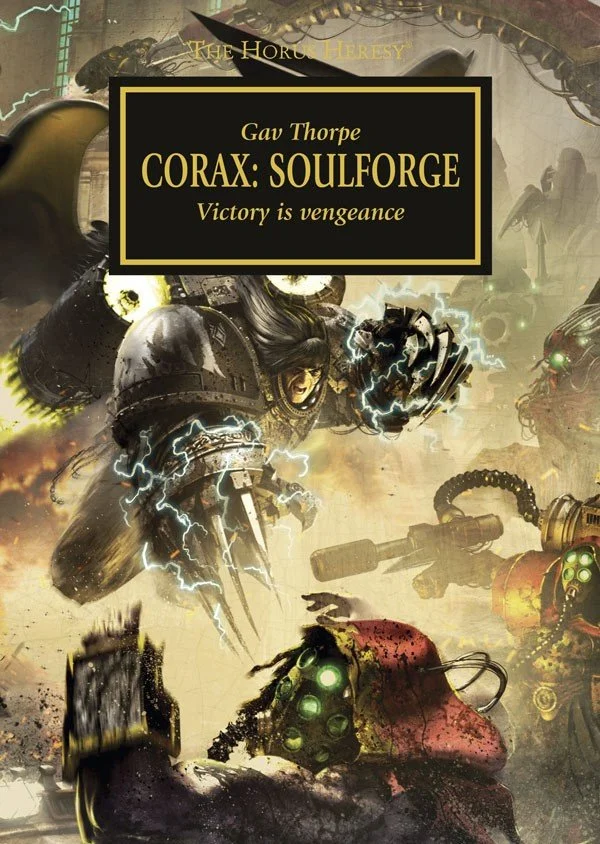
Soulforge – The Raven Guard Strike Back
We then jump back to roughly a year after the events of Deliverance Lost and begin Soulforge.
The Raven Guard are doing what they do best: being sneaky bastards!
We join Corax and his warriors as they raid a Word Bearers ship. Unfortunately, one of the Raven Guard is still consumed by the desire for revenge over Isstvan, and the operation doesn't go quite as smoothly as planned.
It's a good reminder that the Raven Guard haven't simply bounced back from their betrayal. Their numbers have been devastated, their trust has been shaken, and the survivors are still carrying the psychological scars of what happened.
The story explores how the Legion needs to confront that trauma if it's ever going to function as it should again. The action eventually takes us to a Mechanicum world, where the fighting offers a rather different experience from the usual bolter-filled corridors.
The world itself is a highlight for me. Floating barge forges turn the conflict into something resembling a naval engagement, which makes for a refreshing change of scenery. We also get to see the first Defilers in action, which is a nice bonus.
Overall, Soulforge is a cracking start (which is well I’m sharing the cover). It gives us stealth operations, a cool setting and, more importantly, a look at the very human damage left behind by the Heresy.
The Shadowmasters – Masters of the Dark
Next up is The Shadowmasters, which introduces us to another fascinating part of the Raven Guard: the Mor Deythan. These elite warriors appear to have inherited something of Corax's own uncanny ability to move unseen. With their numbers limited, they're used to infiltrate enemy positions and eliminate critical targets. The story doesn't necessarily move the wider narrative forward by a huge amount, but it introduces an interesting faction and gives us a better understanding of what makes the Raven Guard so dangerous.
There's something wonderfully unsettling about an enemy you never see coming. You can build the biggest fortress in the galaxy, but it doesn't mean much if someone can walk straight through your defences without being noticed. For a Legion that specialises in fighting from the shadows, the Mor Deythan are a perfect addition.
Ravenlord – When Your Own Warriors Become the Enemy
Ravenlord takes us deeper into the problems surrounding the Raptors. Corax's attempt to rebuild the Raven Guard has produced warriors who remain loyal, but whose altered appearances increasingly resemble the grotesque creations of the enemy. They may still fight for the Emperor, but to an outsider, the distinction between these loyalists and the monsters created by the likes of Fabius Bile isn't always obvious, and that raises an uncomfortable question. At what point does a warrior stop being a hero and become a monster?
Corax is forced to confront the consequences of his own actions and the secrets he's been carrying. The Raptors are a living reminder of his desperation to restore his Legion, and their existence threatens to undermine everything he's trying to achieve. The story also introduces the possibility that traitors may still be lurking within the Legion. With trust already in short supply, that suspicion only makes matters worse. Paranoia begins to seep into the ranks, and it's difficult not to wonder how much damage Corax's attempts to save his Legion are doing to it instead.
I found Ravenlord particularly intriguing because it challenges the idea that loyalty isn’t enough. These warriors haven't willingly betrayed the Imperium. They've suffered because of the desperate measures taken to save them. But does that mean everyone else has to accept what they've become?
It's a grim question, and I suspect there's no easy answer.
The Value of Fear – A Loyal Night Lord?
Okay, okay, okay. Here's something I wasn't expecting: a loyalist Night Lord! The Value of Fear explores the clash between the Raven Guard and a Night Lord whose approach to warfare is very different from their own. Both Legions understand fear, stealth and the psychological impact of violence. But understanding a weapon doesn't mean agreeing on how it should be used.
The resulting arguments are a great read, and the chase scene is a lot of fun. The ending is clever, too, and left me wanting to see more of these loyal Night Lords. I particularly enjoyed how the story highlights the similarities between the Raven Guard and the Night Lords, despite the very different paths their Legions have taken. Both operate in the shadows. Both understand that a battle can be won before the first shot is fired. Yet one is supposed to be a defender of the Imperium, while the other has embraced its darkest impulses.
It's a fascinating comparison, and one I'd happily explore further.
Raptor – Fear Turns Inwards
Originally an audio drama, Raptor brings us Lieutenant Navar Hef, a heavily mutated Raven Guard warrior leading the Raptors on an investigation of a ship in distress. The vessel turns out to be connected to the Space Wolves, who have made planetfall for one last glorious stand against the Traitors. The Raptors decide to come to their aid, hoping to fight alongside their fellow loyalists. Unfortunately, revealing themselves brings their mutations into the open, and the Wolves struggle to see past their appearance.
Hef's own paranoia and the shame surrounding his warriors make an already difficult situation even worse.
Damn, this is a dark tale. What really struck me was the hypocrisy at the heart of the conflict. The Space Wolves themselves have the Wulfen, a terrible transformation that can turn their warriors into something frightening and difficult to control. Yet when confronted with the mutations of the Raptors, they struggle to show the same understanding they might hope to receive themselves. It's an uncomfortable parallel, and it works brilliantly.
The story also shows just how far Corax's paranoia has spread. His doubts and self-loathing are no longer confined to the Primarch himself. They're infecting his Legion, influencing its commanders and shaping how its warriors view one another. The Raven Guard are supposed to be united by their loyalty, but that loyalty is being tested by fear, shame and the suspicion that their brothers may no longer be what they once were.
I could already see the potential fallout from this story, and I was keen to see where Gav Thorpe would take it next.
Weregeld – The Final Tragedy
Finally, we return to Weregeld and bring the anthology's story arc to its conclusion. The war is drawing closer to Terra, and the Raptors have become a shadow of the force they were supposed to be. Many of the original warriors are dead, while those who remain are increasingly lost to their mutations. Lieutenant Hef survives, but he's a deeply damaged figure. The Raptors' past actions catch up with them, and the consequences are devastating. Corax is left confronting the failures of his own plans, while his attempts to make amends only push him further down a dark path.
In a desperate effort to help the Space Wolves, he sends his allies towards Terra and takes his own forces into a confrontation that will seal the fate of the Raptors. What follows feels less like a triumphant military adventure and more like a tragedy unfolding in slow motion.
Corax is a Primarch, a legendary warrior and a master of stealth. But he's also a commander who has been battered by loss, betrayal and the terrible consequences of trying to save his Legion at any cost. His judgement is increasingly clouded. His commanders question his decisions and motives, and the enemy is perfectly positioned to exploit the chaos. We're getting closer to the final confrontation, yet instead of a growing sense of hope, the story gives us doubt, regret and a terrible feeling that something precious has been lost.
The ending brings the Raptors' arc to a grim conclusion and leaves Corax on a path of self-destruction and self-loathing. It's bleak, but it feels earned.
Final Thoughts
Corax turned out to be a really enjoyable anthology. I went in expecting a collection of Raven Guard adventures, but came away with a much darker story about the cost of survival and the damage that even the most well-intentioned decisions can cause. The different formats worked well for me, too. Having shorter stories alongside the novellas made the book easy to dip in and out of, while the connected narrative gave the collection a sense of direction.
There are plenty of highlights: the floating Mechanicum forges in Soulforge, the Mor Deythan in The Shadowmasters, the unexpected loyalist Night Lord in The Value of Fear, and the increasingly tragic fate of the Raptors. But what really holds everything together is Corax himself.
His determination to save the Raven Guard is understandable, and his actions are driven by loyalty to his warriors. Yet his desperation gradually becomes a weakness, feeding the very paranoia and self-loathing that threaten to destroy what remains of his Legion. The question of whether the Raptors are still heroes or have become monsters is particularly effective. They haven't chosen their mutations, but they must live with the consequences, and so must everyone around them.
If you enjoy the Raven Guard, stories about the psychological cost of war, or watching a Primarch struggle with the consequences of his own choices, I'd definitely recommend giving Corax a read. Now, on to book 41! The Siege of Terra is getting closer, and I'm very curious to see how all these stories finally come together.
Let me know what you thought of Corax. Did I miss anything? And what did you make of the Raptors' fate?
Cheers for reading, and I'll see you on the next adventure!
A Sector 102 Adventure // The Mutants Behind the Mask
(A proposed Sector 102 idea inspired by the anthology.)
One of the strongest themes in Corax is the fear that loyal warriors can become so changed by their experiences that their allies no longer recognise them as friends. Let's bring that idea into Sector 102.
Imagine a Justice Department recovery team sent into an abandoned research facility beyond the city walls. The facility was once developing treatments for radiation sickness and mutation, but its records were lost after a catastrophic incident. The team discovers a group of heavily mutated survivors still living inside, lead by Judge who seems also affected. They claim to be loyal citizens who were abandoned by the authorities, and they desperately want to return to civilisation.
Unfortunately, their appearance suggests something far more sinister. Their bodies have changed, their behaviour is unpredictable, and some of the surviving security systems identify them as hostile biological threats. Are they dangerous mutants who have lost control, or victims who have been abandoned because the authorities are afraid of what they've become?
The tabletop campaign could begin as a straightforward search-and-rescue mission, then slowly reveal the truth through data terminals, abandoned laboratories and encounters with the survivors. Later scenarios could involve protecting the mutants from an extermination squad, escorting them to safety, or deciding whether the threat is too great to ignore.
The fun comes from making the players question their orders. Do they follow Justice Department protocol, or risk everything to protect people who might no longer be accepted as human?
Because in Sector 102, the line between hero and monster isn't always marked on the miniature.
Sometimes, it's a decision made by the person holding the gun.